
Mobile Products & Growth
How to Get Your First 1,000 Users for a Mobile App or Game
A practical plan for your first 1,000 mobile app or game users, connecting audience research, ASO, short videos, paid experiments and meaningful measurement.
Updated: 2026-10-18
Define what counts as a user first
Your first 1,000 users do not have to come from one viral post or a single campaign. A stronger starting point is a repeatable system that reaches relevant people, helps them experience the product’s value and improves through feedback. The 30-day schedule below is a working plan, not a promise of 1,000 users in a month.
Set separate goals for downloads, first opens, registrations and meaningful use. Completing the first puzzle or saving a first city-exploration task could be a useful activation milestone. These are illustrative product examples, not measured growth results for SourSpark projects.
Start with one audience instead of everyone
“People who enjoy mobile games” is too broad to guide a useful experiment. A more concrete starting group might be English-speaking players who want offline puzzles during short breaks. For an app, define the audience through a job, a habit or a task they need to complete. Starting with one language, market and use case makes it easier to understand why a message works.
Write down who you want to reach, the problem you solve, the first action you expect and where those people discover products. Record what you learn before changing these assumptions. Changing the country, price and product promise together makes the outcome harder to interpret.
Make the store page deliver on the video’s promise
The icon, title and first screenshots should describe the same experience. If a video shows a puzzle solved with one tap, that interaction should also be clear on the store page. Localization includes search phrasing, examples and text inside images, not just a translated description.
Apple’s product page optimization supports testing icons, screenshots and previews. Avoid declaring a winner from a tiny difference in limited traffic. Fix clear misunderstandings first, then test one hypothesis. Compare results within the same country, language and traffic source rather than treating every visitor as interchangeable.
Use the first small group to learn
Try to find an initial group of 20–50 people who could realistically use the product. This is a suggested discovery group, not a statistical sample-size rule. Share a relevant demonstration in communities that allow it, announce the product to an existing audience or arrange short sessions with willing participants. Respect community rules and avoid mass direct messages or repeatedly dropping the same link.
Do not explain every step during a session. Observe where people pause, which wording confuses them and whether they complete the first valuable action. Fix recurring problems before bringing in more traffic. Fake downloads, fabricated reviews and rewards for positive ratings do not build a useful user base.
Show a moment of use in short videos
Try three openings for a piece of content: a small problem to solve, an unexpected outcome and an everyday task made easier. Show the real screen or gameplay early. Promising a feature that is absent from the product creates an expectation the store page cannot fulfil.
For example, a brick-breaking game could show the chain reaction from one shot; a city-exploration app could show someone finding a first task. Treat views as one signal, not the final result. Compare the source link, store traffic and first valuable in-product action for each piece. Reusing a clear demonstration with a different opening can teach you more than constantly describing new features.
Measure clicks, installs and activation separately
Google Play distinguishes listing click intent from completed acquisition; verify installs in the relevant acquisition report. Likewise, a click on your website’s store link does not prove an installation. Keep website analytics and in-app measurement distinct.
Create an event plan for the first app open, the first valuable action and subsequent returns. tutorial_complete is an example for the end of a tutorial; it needs implementation and verification in your product. Separate test devices, avoid unnecessary personal data and document what your measurement system counts as a user. A device-based total should not be presented as a count of unique people.
Suppose an illustrative worksheet contains 1,000 store visits, 150 verified installs and 60 people completing the first action. Visit-to-install conversion is 15%, and install-to-activation conversion is 40%. These numbers are a calculation example, not a benchmark. If acquisition looks healthy but activation is weak, investigate the first-use experience before scaling distribution.
Give paid experiments a decision boundary
Once organic content helps people understand the product, consider a small, bounded paid experiment. Define the country, creative, total spending limit, review date and stopping condition in advance. The purpose is to learn whether a particular audience and message bring valuable users, rather than simply spending the available budget.
Look beyond cost per install. Compare activation and return behaviour among users acquired through the same campaign. Divide spending by a verified outcome from the same source and time window; do not combine incompatible reporting periods. Cheap installs do not establish product use or revenue. Repeat a promising result before making a large budget increase.
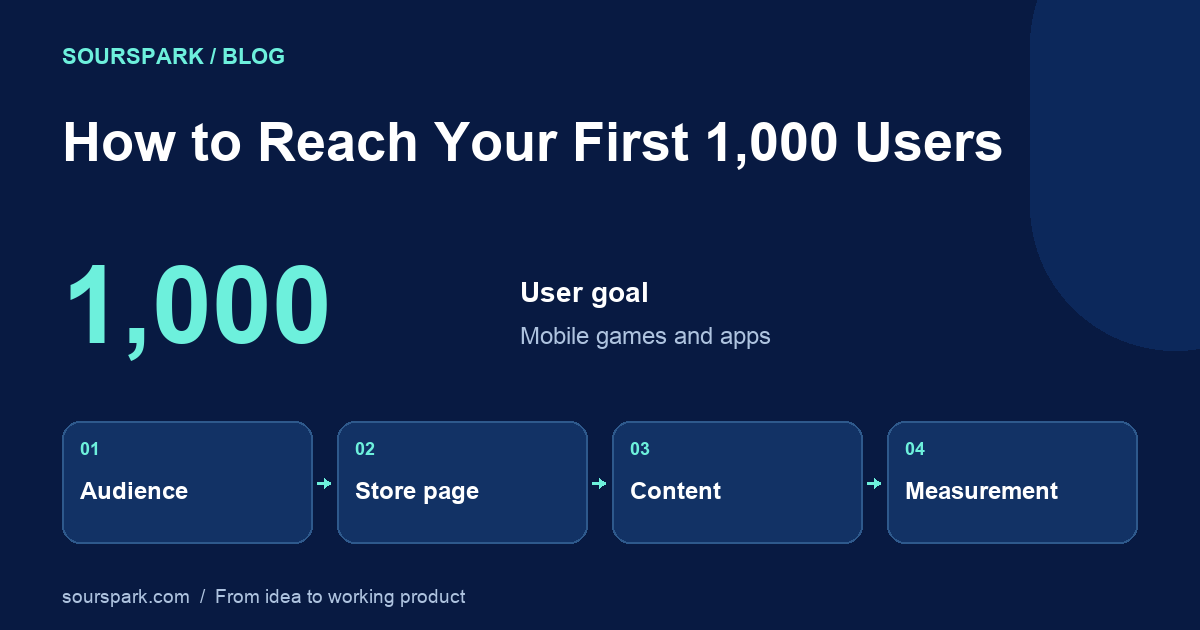
Break the first 30 days into four learning cycles
At the end of the first month, you should be able to explain which people arrived through which message and what they did next. If a channel struggles, distinguish a discovery problem from weak store interest or an in-product obstacle before changing everything.
The first-1,000-user goal becomes more manageable when you repeat a small loop that works. Traffic with weak activation calls for a better first-use flow. Healthy activation with weak returns calls for a reason to use the product again. When people return but discovery is limited, invest more effort in clear content and distribution experiments.
- Days 1–7: Choose one audience and activation milestone; prepare the store message and measurement.
- Days 8–14: Observe a small user group and fix recurring first-use problems.
- Days 15–21: Publish short videos with different openings; compare sources and user quality.
- Days 22–30: Repeat the most promising approach and, if useful, run a paid test with a defined spending limit.
Frequently asked questions
Can I get my first 1,000 users without advertising?
It is possible, but the outcome depends on your existing audience, product fit and distribution channels. Organic traffic also requires time for content and community work. It should not be treated as guaranteed growth with no cost.
How much advertising budget do the first 1,000 users require?
There is no fixed budget that applies to every product. Start with a small capped experiment to measure verified acquisition cost and activation quality. Multiplying an assumed cost by 1,000 without this evidence is not a reliable plan.
What should I do immediately after launching?
Verify the first-use flow and measurement on a real phone. Then test whether a narrow audience understands the store promise. If early users repeatedly get stuck in the same place, solve that problem before buying more traffic.
SourSpark
Let’s plan your first users together.
Share your app or game, target audience and existing data so we can build a practical starting plan for the product, store and distribution.
Discuss my growth plan